skip to content
Alejandro Rico

Murder Sudoku: Tiny Crimes

Written by hand, in seven languages

True crime became mainstream entertainment, and a genre of deduction puzzles grew up around it. This is the part of one of them that a screenshot cannot show.

True crime went mainstream, and a shelf of deduction puzzle games grew up around it: a grid, a cast, a handful of statements, the promise you can reason your way to the killer. Tiny Crimes is one of them. What follows is the work underneath: the writing, the logic, and the drawing.

#1
App Store result for the search “murder sudoku” in the US, UK, Canada, Australia, Germany, Ukraine and Brazil.
4.8
App Store rating.
7
languages ship complete: English, Spanish, Catalan, German, Dutch, Portuguese, Ukrainian. The first three are written by hand.
1
person. Code, puzzle engine, art direction, copy, and both of the native languages.

Checked 24 July 2026 across twelve storefronts: first in seven, second or third in Spain, France, Italy, the Netherlands and Portugal.

1. The Spanish and Catalan are not translations

Most games translate. English goes out, other languages come back, everything ships in the same shape.

Tiny Crimes does not work that way in Spanish or Catalan. Both are native languages of the person who makes the game, and he writes them himself, from scratch, as if the English did not exist. Sometimes the result tracks the English closely. Sometimes it throws the English out and writes a better joke for that audience. He hand-writes the English too. Those three languages are written, not translated.

None of this is visible if you do not read the language. So here it is, shown: the English line, a literal back-translation so you can see the mechanism, and the line that actually ships.

Murder Next Door · Casebook blurb, 1 of 4

English

A friendly little street with tidy gardens, curtain-twitchers on duty, and a body on the rug every other week. Time to put the neighbors in their place.

ES, literally

A most agreeable street: tidy gardens, old women at the net curtain, and a body on the rug week yes, week no. Time to put each neighbour in his place.

ES, as shipped

Una calle de lo más agradable: jardines cuidados, viejas en el visillo y un cadáver en la alfombra semana sí, semana no. Toca poner a cada vecino en su sitio.

CA, literally

A street of the most agreeable: trim gardens, grannies at the window, and a body on the rug week yes, week no. Time to put light into the dark, and each neighbour in his place.

CA, as shipped

Un carrer d'allò més agradable: jardins polits, iaies a la finestra i un cadàver a la catifa setmana sí, setmana no. Toca posar llum a la foscor i cada veí al seu lloc.

The Spanish is written in the register of a long-running neighbourhood sitcom, down to viejas en el visillo, the stock phrase for the woman who watches the street from behind her net curtain. The Catalan reaches instead for posar llum a la foscor, “to put light into the dark”, a turn of phrase that true-crime television made common there. Both keep the English pun: putting the neighbours in their place is also, literally, how you solve the board.
Dead Man’s Cove · Casebook blurb, 2 of 4

English

The tide erased the trail, but not the lies. Every island keeps a secret.

ES, literally

Postcard coves, bonfires at dusk, and footage nobody wants to see. Nobody comes out of this experience alive.

ES, as shipped

Calas de postal, hogueras al atardecer e imágenes que nadie quiere ver. De esta experiencia uno no sale vivo.

CA, literally

Postcard coves, bonfires at dusk, and footage nobody wants to see. Not everyone comes out of this experience alive.

CA, as shipped

Cales de postal, fogueres al capvespre i imatges que ningú vol veure. D'aquesta experiència no tothom en surt viu.

Here the Spanish and Catalan throw the English line away and deadpan a reality dating show instead, La isla de las tentaciones: postcard coves, bonfires at dusk, footage nobody wants to see. The last sentence takes that format's solemn line about surviving the experience and makes it literal, because this time there is a corpse.

Dead Man’s Cove · Casebook blurb, 3 of 4

English

Towels are folded, parasols are open, and someone never came back from the swim.

ES, literally

The towels are folded, the parasols open, and somebody didn't come back from the swim.

ES, as shipped

Las toallas están dobladas, las sombrillas abiertas y alguien no volvió del baño.

CA, literally

The towels folded, the parasols open, and somebody who hasn't come back from the swim. Let's begin.

CA, as shipped

Les tovalloles plegades, els para-sols oberts i algú que no ha tornat del bany. Comencem.

The Spanish stays close, because the English already works. The Catalan adds one word: Comencem, “let's begin”, is how the true-crime programme Crims opens an episode, so a Catalan reader hears the narrator's voice before the case has even started.

None of it is accidental. The intent is written into the source file, beside the string:

"casebookIslandsLore2": "The tide erased the trail, but not the lies. …",
"@casebookIslandsLore2": {
  "description": "… ES/CA intentionally diverge from the English: they
   deadpan-parody the reality show 'La isla de las tentaciones' …
   Keep locale-native humor; do not translate the English literally."
}

Murder Next Door and Dead Man's Cove each carry four of these blurbs and rotate one per week, so the shelf reads a little different from one week to the next.

2. Each environment changes what a clue can say

In most puzzle games a new environment is a new palette. Here it is a new set of questions.

The rules never move: one suspect per row and column, every statement is true, and whoever is left alone with the victim did it. What changes is what a statement is allowed to be about.

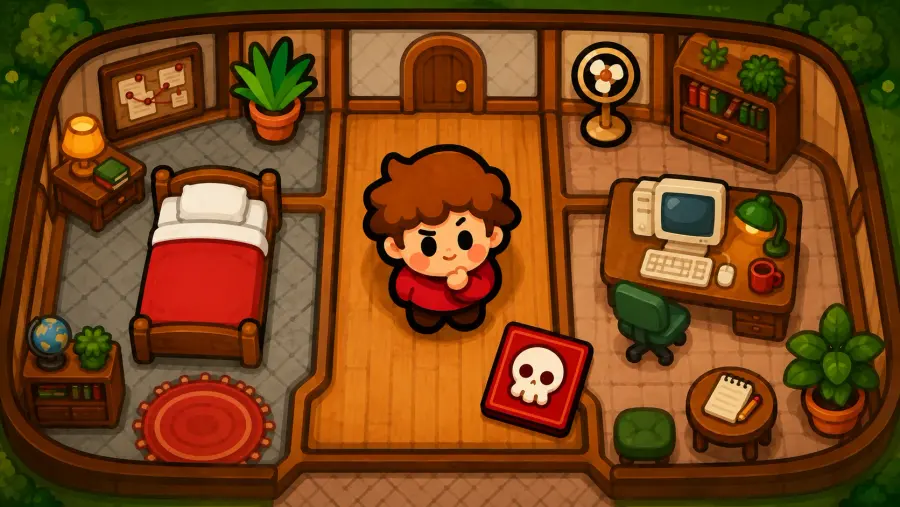
Murder Next Door board art

Murder Next Door

Live

A house seen from above. Walls, doorways, furniture.

  • “was in the Kitchen”
  • “was with Elsie”
  • “was alone”
  • “was not beside any furniture”
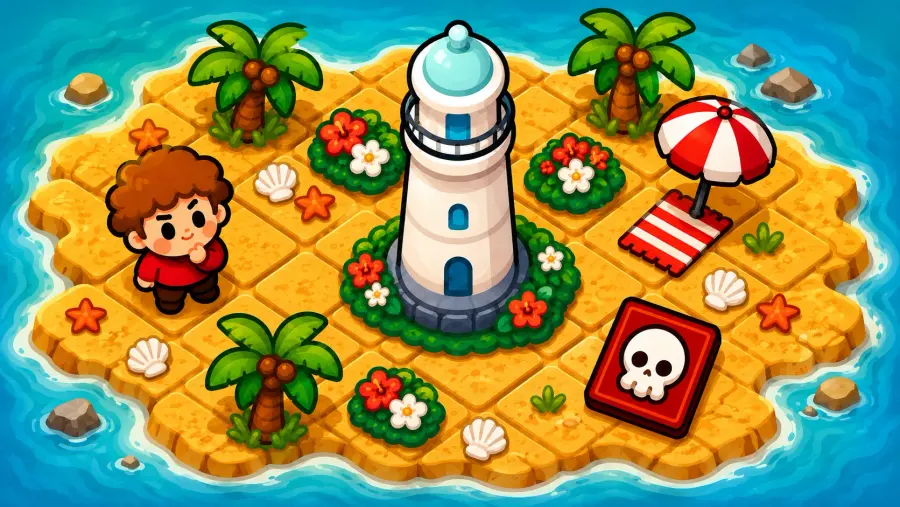
Dead Man’s Cove board art

Dead Man’s Cove

Live

An archipelago. No walls at all, so the water does the dividing.

  • “was on Sa Palma Island”
  • “was at the water’s edge”
  • “was on land”
  • “was in the eastern half of the map”
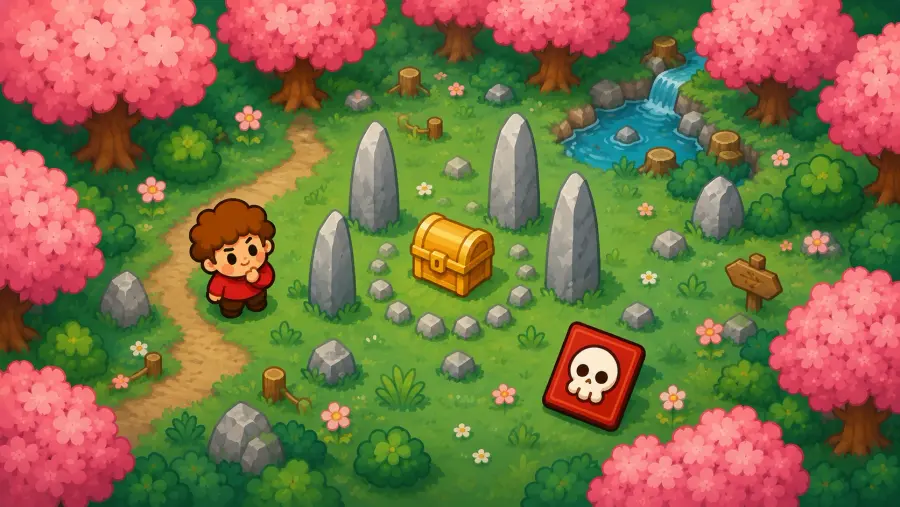
Grove in Pink board art

Grove in Pink

Ships in 1.12.0, awaiting review

A wood around one clearing, with a golden chest to measure from.

  • “was in the clearing”
  • “was 2 rows north of the golden chest”
  • “was beside more trees than Elsie”
  • “was beside exactly 2 trees”

Those lines are real clue text from the game. A player fluent in walls and doorways has to relearn the board when the walls become water, and again when the map starts measuring distances to a golden chest.

Underneath all three, the same guarantee. Every case is generated from a seed, then run through the engine's own deduction rules. If it cannot be solved by reasoning alone, or if more than one answer survives, it is thrown away and the generator tries again. There is never a guess.

3. None of the art is generated

The three images above are the real headers from the app. The suspects, the props and the terrain are licensed from RhosGFX, an illustrator, with full commercial rights. The layouts, the autotiling, and the work of keeping three environments in one style are done here. Not a pixel of it is AI-generated, which is a choice, and an increasingly unusual one.

That is also why there are three environments and not thirty. Each one needs art, a layout generator, its own clue vocabulary, and copy in seven languages that reads like it was written there rather than imported.

The game grows at the speed of one person's taste. That is the constraint and the point.